
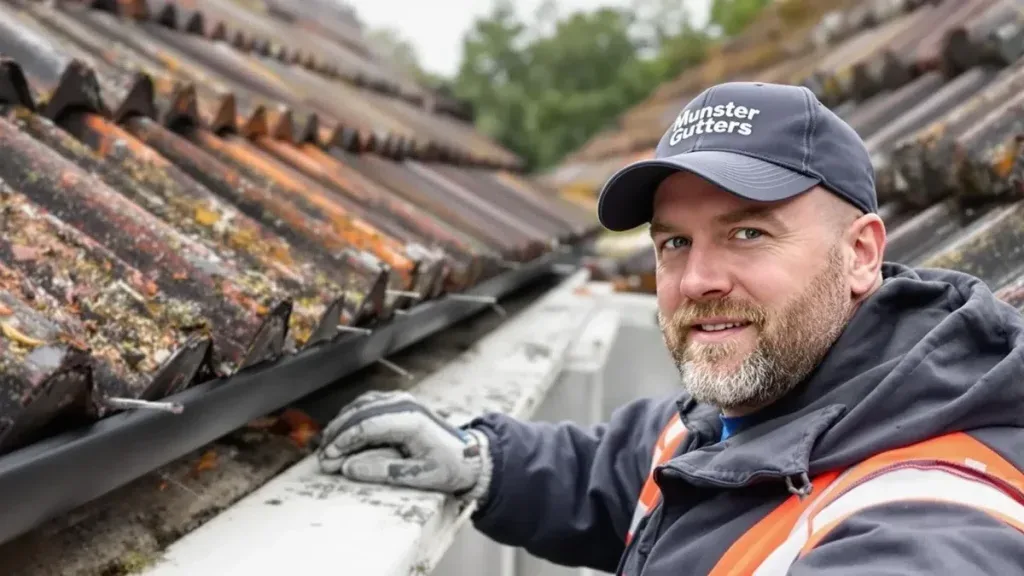
County Kerry doesn't ease you in gently. The Atlantic rolls in off the Dingle Peninsula and the Iveragh coastline with salt-saturated air that strips paint, pits metal, and works its way under slates before most homeowners even notice the damage is beginning. This isn't the milder coastal exposure you find further east — Kerry's western edge faces the open ocean, and roofing materials here are under stress that inland counties simply don't experience to the same degree. Whether you own a guesthouse on the edge of Killarney, a farmhouse on the road to Cahersiveen, or a terraced home in Castleisland, your roof is working harder than you think. Munster Gutters has been carrying out professional roof repairs across Munster since 2010, and our experience along the Kerry coastline and throughout its inland towns means we understand exactly what these roofs are up against. We're council-approved, carry €6.5 million in public liability insurance, and back our work with guarantees from a minimum of 3 years up to 10 years on major repairs. Every job starts with a free, no-obligation quote.
Roof Repair Types We Cover Across County Kerry
Roof Leak Repair
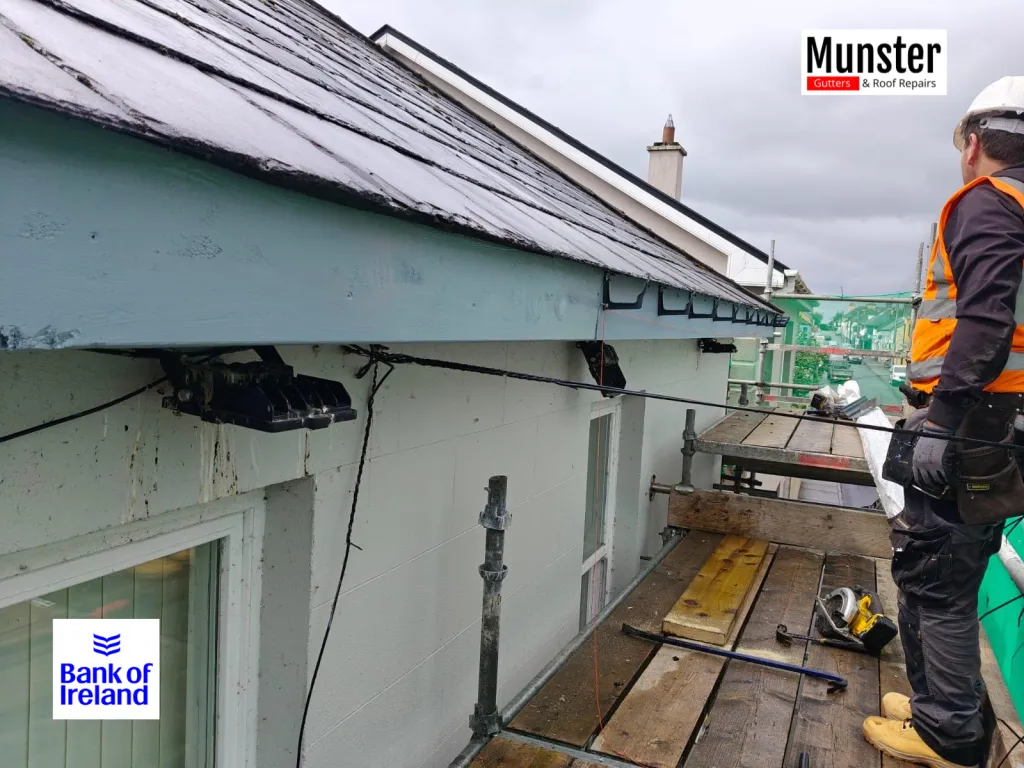
Kerry's combination of high rainfall and driving westerly winds means leaks here rarely come through the roof face alone — wind-driven rain finds its way in at junctions, along verges, and through the smallest gaps in flashing. A leak showing up on a ceiling in Killarney during a heavy night of Atlantic rain could have its origin point several metres away from where the water appears. Our Kerry leak investigations start at the most exposed elevations first. We trace every route the water is taking before we lift a single slate, so the repair is permanent rather than a temporary stop-gap.
Slipped or Missing Slates
Natural slate is the traditional roofing material across Kerry and it performs well for decades — but only when the nibs and nails holding each slate in place are intact. Salt-laden air from the coast corrodes the original iron nails faster than it would in sheltered inland areas, and once a nail fails the slate below it is free to slip. We see this regularly on older properties in Dingle and on the exposed western faces of farmhouses out along the Ring of Kerry. Slipped slates let in water immediately and, if left, the battens and felt beneath begin to deteriorate. We source matching natural slate where possible to preserve the character of traditional Kerry roofs.
Ridge Repointing
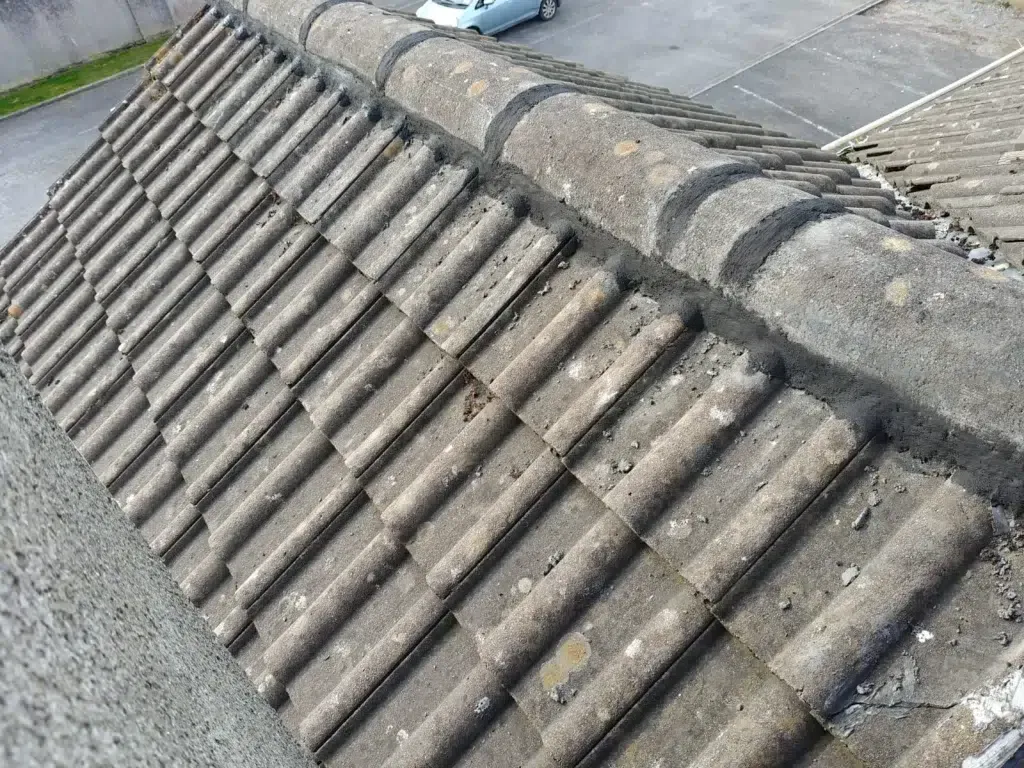
The mortar bedding the ridge tiles along the apex of your roof takes the worst of Kerry's wind because it sits at the very highest, most exposed point. Freeze-thaw cycles through winter, combined with the salt content in coastal air, break down even well-applied mortar over time. Loose or cracked ridge mortar allows wind to lift ridge tiles entirely — a genuine safety hazard, particularly in towns like Killorglin where properties sit close together. Ridge repointing is one of the most cost-effective preventative repairs a Kerry homeowner can invest in, and it's work our teams carry out throughout the county every week.
Chimney Flashing Repair
Step flashing and lead soakers at chimney bases are among the most common failure points on Kerry roofs. The thermal movement chimneys go through — heating up when in use, cooling overnight — gradually breaks the bond between flashing and mortar, and once that seal opens, water runs straight down into the roof space. Salt corrosion accelerates the deterioration of lead and zinc flashings on coastal properties in and around Dingle and further south on the Iveragh Peninsula. We rebed and repoint chimney flashings to a standard that stands up to Kerry's conditions, using appropriate materials for each roof's age and exposure.
Flat Roof Repair
Extensions, outbuildings, and commercial premises throughout Kerry carry flat or low-pitch roofs that require different maintenance to pitched slated roofs. Ponding water, split felt membranes, and failed upstands are the most common issues we encounter. In a county with Kerry's annual rainfall figures, a compromised flat roof deteriorates rapidly. We work with modern single-ply membranes, torch-on felt, and EPDM rubber systems, selecting the right solution for each building's age, use, and budget. Flat roof work in Tralee on commercial buildings differs considerably from a domestic rear extension in Castleisland — we approach each job on its own terms.
Cracked or Broken Tiles
Concrete and fibre-cement tiles are common on Kerry homes built from the 1970s through to the early 2000s. Impact damage from storm debris, and the natural brittleness that develops in older concrete tiles after years of exposure, leads to cracking that lets water directly into the batten zone. We assess whether individual tile replacements are sufficient or whether a section of the roof needs more systematic attention, particularly on south and west-facing slopes that bear the brunt of Kerry's weather.
Roof Felt Replacement
Beneath the slates or tiles, the roofing felt acts as a secondary barrier. On older Kerry properties — and there are many, given the county's strong tradition of traditional farmhouse and cottage architecture — original bitumen felt has often long since become brittle and perforated. In some cases it has degraded to the point where it offers no protection at all. Felt replacement is a more involved repair that we carry out section by section where possible to minimise disruption, using modern breathable membranes that suit Kerry's humid, salt-laden air far better than older non-breathable materials.
Valley Repair
Lead valleys where two roof slopes meet are high-risk areas on any roof, but particularly so on the complex rooflines of older Kerry properties — converted farmhouses, extended cottages, and traditional townhouses often have several valley junctions. Valley lead expands and contracts with temperature changes and, over time, splits or lifts at the edges. When a valley fails, water channels directly into the roof structure rather than being carried safely to the gutters. We dress and replace valley lead to the correct gauge for each application, taking into account the pitch angles and water volumes each valley has to handle.
Storm Damage Repair
Named Atlantic storms hit Kerry harder than almost anywhere else in Ireland. When a storm strips slates, lifts ridge tiles, or forces water through previously sound flashings, the priority is a fast, safe response. Our teams cover all of Kerry — from Kenmare in the south to Listowel in the north — and we carry out post-storm inspections promptly. We document all storm damage thoroughly, which assists with insurance claims, and we carry out emergency temporary weatherproofing where a permanent repair cannot be completed immediately. Our €6.5 million insurance cover means you are protected throughout any work we do on your property.
Moss and Algae Removal
Kerry's damp, mild climate — the same conditions that produce the county's famous lush greenery — is ideal for moss and algae growth on roof surfaces. North-facing slopes and roofs shaded by mature trees are particularly prone. Beyond the appearance, heavy moss holds moisture against the slate or tile surface, accelerating freeze-thaw damage and working its way into joints. Biocide treatment followed by careful mechanical removal is the correct approach; high-pressure washing alone can dislodge slates and damage pointing. We apply long-lasting biocide treatments that inhibit regrowth and protect Kerry roofs between treatment cycles.
Why Kerry Homeowners Choose Munster Gutters
Munster Gutters has been working in County Kerry since 2010, and our understanding of the county's roofing conditions goes well beyond the general. We know that a roof on the Dingle Peninsula faces a fundamentally different environment to one in Castleisland ten miles inland, and we specify materials and methods accordingly. We know the slate traditions of Kerry, the common failure patterns on mid-century housing estates in Killarney, and the particular demands of tourism-facing properties that cannot afford extended periods of disruption.
- Council-approved contractor — meeting the standards required for local authority and residential work across Kerry.
- €6.5 million public liability insurance — comprehensive cover on every job, large or small.
- Guarantees from 3 to 10 years — a minimum 3-year guarantee on all repairs, with up to 10 years on major structural work.
- Free, detailed quotes — no call-out charge, no obligation, and a written scope of work before anything is agreed.
- Serving all of County Kerry — from the tourist towns and coastal peninsulas to the rural townlands in between.
- Over 14 years of Munster roofing experience — not a franchise, not a recently established operation; a company with a genuine regional track record.
We don't offer one-size-fits-all repairs. Kerry roofs need Kerry knowledge, and that's what we bring to every job.
Roof Repairs Kerry — FAQs
How quickly does salt air from the Kerry coast actually damage a roof?
The effect is gradual but significant and cumulative. On properties within a few kilometres of the Kerry coastline — particularly on western and south-western elevations facing the Atlantic — the combination of salt particles, high humidity, and wind-driven moisture can corrode iron fixings and degrade mortar noticeably faster than the national average. Original iron nails in Victorian and early twentieth-century slated roofs in coastal areas like Dingle can fail within 30 to 40 years rather than the 60 to 80 years you might expect further inland. Annual inspections are genuinely worthwhile for coastal Kerry properties — catching a dozen slipping slates early is far less costly than dealing with the water damage that follows if they are ignored.
I have a traditional slate roof on my Kerry farmhouse — should I replace like-for-like or is modern tile acceptable?
Where budget allows, like-for-like natural slate is nearly always the right answer for traditional Kerry farmhouses and cottages. Beyond aesthetics and planning considerations, natural slate is extraordinarily durable, performs very well in Kerry's wet and salt-affected climate, and adds to property value. Concrete tiles are a practical alternative when budget is the primary constraint, but they are heavier than natural slate and the roof structure should be assessed before any switch is made. We will always give you an honest assessment of both options — including cost, longevity, and any structural implications — and let you make an informed decision.
Are roof repairs in Kerry eligible for any grants or schemes?
The SEAI Better Energy Homes scheme and the One Stop Shop service can cover roof insulation works where these are carried out alongside energy upgrades, and Kerry County Council administers certain housing adaptation and repair grants for qualifying households. These are distinct from general roof repair costs, but in some cases a repair project and an insulation upgrade can be coordinated to maximise grant eligibility. We recommend speaking to Kerry County Council's housing department directly about current grant availability, and we are happy to provide the documentation and costings that grant applications typically require.
What should I do immediately after storm damage to my roof in Kerry?
Safety first — keep away from any slates, tiles, or ridge pieces that have fallen to the ground, as further material may still be loose. Do not attempt to access the roof yourself. If there is an active leak into the property, place containers, move valuables, and protect floors, but do not go into the attic space during or immediately after a storm. Contact us as soon as it is safe to do so and we will arrange an inspection promptly. We carry out emergency weatherproofing — temporary covering and securing of exposed areas — where a full repair cannot be completed on the same visit. Photograph the damage as early and safely as you can, as this supports any insurance claim you may wish to make.