By Patrick Foley, Business Owner
Gutter Installation in Munster, Tools and Materials at a Glance
- Munster Gutters installs uPVC, aluminium and cast-iron guttering across all six Munster counties, with the right material matched to each property and location.
- A successful installation depends on accurate measurement, correct sizing for Atlantic rainfall levels, and properly sloped runs that carry water to the downpipes.
- Key tools on every job include a tape measure, spirit level, tin snips, a cordless drill and appropriate fixings for the material being fitted.
- Fasteners, sealants, brackets, end caps and downpipe connectors are as important as the gutter section itself, poor-quality accessories are a common cause of early failure.
- All replacement work carries a 10-year guarantee plus the Lifetime Leak Guarantee; repair work carries a minimum of 3 years, up to 10 on major repairs.
How a Gutter System Works
A gutter system does one job: it collects rainwater from the roof and carries it safely away from the walls and foundations of the building. In Munster, where Atlantic weather delivers heavy and prolonged rainfall, a well-sized and well-installed system earns its keep every winter. When it fails, through blockage, sagging or a leaking joint, the water has to go somewhere, and it usually goes into the fabric of the building.
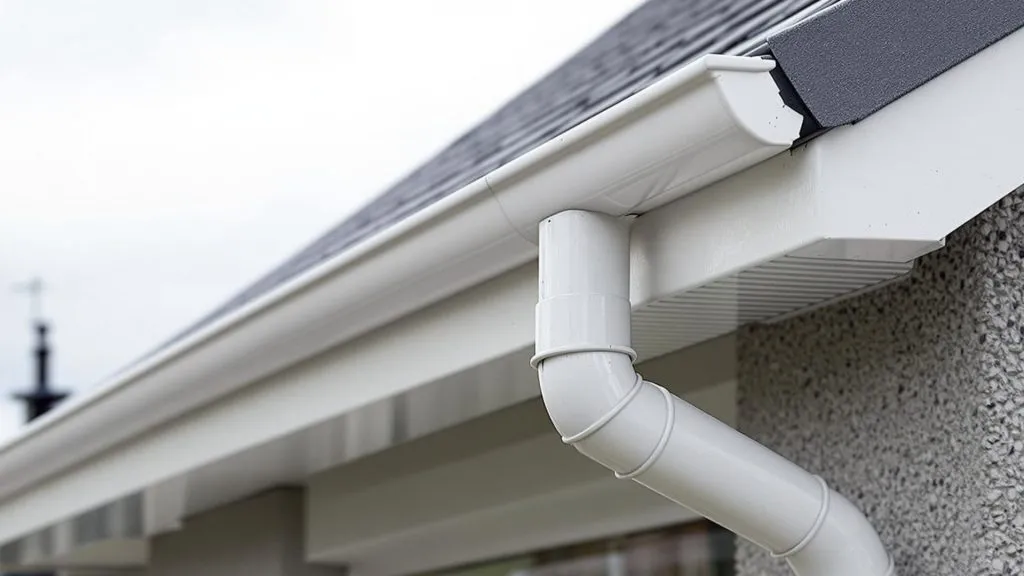
The system has more components than most homeowners realise. The gutter sections themselves are only part of it. Gutter hangers and brackets hold the run at the correct fall, typically about 3 mm drop per metre, so that water moves toward the outlet rather than sitting and overflowing. End caps close off the run at each corner. Outlets connect the gutter to the downpipe. Downpipe brackets hold the pipe against the wall. Unions and angles join sections and carry the run around corners. Every one of these components needs to be the right size, properly fitted and compatible with the material of the rest of the system.
Gutter Types Available in Munster
The most common gutter profiles you will encounter across Munster homes are half-round, square-line (sometimes called box profile) and deep-flow. The right choice depends on the roof area, the rainfall exposure of the site and, on older properties, the profile of the existing system.
| Profile | Best suited to | Notes |
|---|---|---|
| Half-round | Period properties; matching cast-iron originals | Classic appearance; available in uPVC, aluminium and cast iron |
| Square-line / box | Modern and post-war housing | Clean, contemporary look; widely available in uPVC |
| Deep-flow / high-capacity | Exposed sites, large roof areas, coastal locations | Carries more water per metre; important on Kerry and west Cork properties |
Gutter Materials
Material choice is the single biggest decision in any gutter installation. It affects the initial cost, the maintenance requirement, the lifespan of the system and, in conservation areas, whether planning conditions are satisfied.
| Material | Suitable for | Installed rate per metre | Lifespan |
|---|---|---|---|
| uPVC | Most modern and post-war homes | €50, €65 | Standard |
| Aluminium | Coastal and exposed properties; marine-grade options for salt-air environments | €65, €75 | Long |
| Cast iron | Period properties, heritage buildings, conservation areas | €75, €90 | 60, 80+ years |
These rates are per metre installed and include brackets, fixings and outlets. What moves the final price is the length of the runs, the number of downpipes, the height of the building, access conditions and whether the old system needs to be removed and disposed of.
uPVC
uPVC is the standard choice for the majority of homes built in Munster from the 1960s onward. It is lightweight, easy to work with, resistant to rust and available in a wide range of profiles and colours. A typical semi-detached house with roughly 20 metres of guttering comes in at €1,000, €1,400 fully installed. For a larger or detached property with around 50 metres, expect €2,900, €3,600.
Aluminium
Aluminium is the better material for exposed coastal sites, in Cobh, Kinsale, Ballybunion, Dingle, Dungarvan or anywhere else that gets consistent sea-salt air. Marine-grade aluminium fixings resist corrosion where standard fittings would fail within a few years. The installed rate is a little higher than uPVC, but the longer service life makes the difference worthwhile on the right property.
Cast Iron
Cast iron is the correct material for Georgian and Victorian properties, for listed buildings and for conservation areas where planning conditions require authentic rainwater goods. We install new cast-iron guttering, restore and repair existing runs, and fit cast-iron-effect aluminium where the authentic look is wanted without the full cost of the original material. A properly maintained cast-iron system will last 60 to 80 years or more, far longer than uPVC. The trade-off is weight and cost; cast iron needs correctly sized and spaced brackets, and restoration work on a deteriorated run requires welding skills that most general contractors do not carry.
Cork City has a significant stock of Georgian and Victorian terraces with original cast-iron guttering. The same is true of Limerick's Newtown Pery area, the historic core of Clonmel and Cashel in Tipperary, and period properties across Waterford City and Lismore. If you are in one of those areas and your existing system is cast iron, replacing it like for like is usually the right call, and in some locations it is required.
Essential Tools for a Professional Gutter Installation
The tools used on a gutter installation fall into three groups: measuring and marking, cutting and shaping, and fixing and sealing. Getting any of these stages wrong adds up to a system that leaks, sags or pulls away from the fascia within a few years.
Measuring and Setting Out
- Steel tape measure, for the full length of each run and the position of every outlet and downpipe.
- Spirit level or laser level, to set the fall along the run. A gutter that sits perfectly level will pool water at the far end; one that falls too steeply will overflow at the outlet during heavy rain. The correct fall is gentle and consistent.
- Chalk line, for marking the bracket positions along the fascia before fixing begins.
Cutting and Shaping
- Tin snips or a fine-tooth hand saw, for cutting uPVC sections cleanly and squarely. A hacksaw also works; a coarse blade tears the material and leaves a ragged edge that is hard to seal.
- Mitre saw, for angled cuts at internal and external corners, particularly on aluminium.
- File or deburring tool, to clean up the cut edge before fitting, especially important on aluminium where a sharp edge inside a joint can work loose over time.
Fixing and Sealing
- Cordless drill, for driving the bracket screws into the fascia. A drill rather than a screwdriver makes it easier to get consistent depth without cracking uPVC brackets.
- Stainless steel or galvanised screws, standard screws rust and stain the fascia. In coastal areas, stainless steel is essential.
- Gutter sealant / silicone, for every union joint and corner piece. The right sealant is flexible enough to move with thermal expansion and contraction without cracking.
- Pop rivet gun, used on aluminium systems where screw fixings are not suitable at a joint.
Safe Access
Working at height on a ladder is the most significant risk in any gutter installation. A good-quality extension ladder with non-slip feet, placed at the correct angle and tied or footed at the base, is the minimum requirement. On a two-storey building with restricted access, along a busy footpath or beside a public road, a cherry picker or scaffolding may be the right solution. Where scaffolding is genuinely needed, it is priced as a separate line on the quote so you can see exactly what it costs. It is never buried in the job price.
Components and Accessories
Beyond the gutter section and the downpipe, a complete installation includes a set of smaller components that are easy to overlook and expensive to get wrong.
| Component | Function |
|---|---|
| Fascia brackets / gutter hangers | Hold the gutter at the correct height and fall; spaced at 600, 1,000 mm centres depending on material and exposure |
| Running outlets | Connect the gutter run to the downpipe; positioned at the lowest point of each run |
| Stop ends / end caps | Close off the open end of each run; usually sealed with silicone as well as clipped |
| Union clips / couplers | Join sections of gutter; the joint must be sealed and must allow for thermal movement |
| Angles (internal and external) | Carry the run around corners of the building |
| Downpipe brackets | Fix the downpipe to the wall at 1,200, 1,800 mm centres; more in exposed locations |
| Downpipe connectors and offsets | Bridge the gap between the outlet and the wall surface, and carry the pipe around obstacles |
| Swan-neck / offset bends | Connect the outlet to the downpipe where the pipe runs close to the wall |
| Shoes | Direct the water away from the wall at the base of the downpipe and into the drain |
Sizing, Getting It Right for Munster Rainfall
Gutter sizing is frequently underestimated. The standard 112 mm half-round or 100 mm square-line gutter that suits a modest house in a sheltered location can be inadequate for a large roof area, a steeply pitched roof or an exposed western site in Kerry or west Cork. Under-sized guttering overflows in heavy rain regardless of how well it was fitted.
The relevant factors are the plan area of the roof drained by each section of gutter, the pitch of the roof (which increases the effective catchment area), the location and spacing of downpipes, and local rainfall intensity. Met Éireann rainfall data for the relevant area gives a reliable basis for the calculation. Where there is any doubt, it is worth going up a size, the cost difference between a 112 mm and a 150 mm gutter run is modest compared to the cost of repairing plaster damage caused by chronic overflow.
For detailed information on rainfall patterns across Munster, the Met Éireann website publishes county-level rainfall records that are useful for this calculation.
Preparation Before Installation Begins
A good installation starts before the first bracket goes up. The fascia board behind the gutter needs to be sound, rotten timber will not hold brackets securely, and fitting new guttering to a failing fascia means the job will need to be done again within a few years. If the fascia is soft or has signs of decay, the sensible approach is to replace it at the same time as the guttering. Our fascia and soffit service covers this as a combined job.
The old gutter system needs to come down cleanly, with the waste removed from the site. Old cast iron is heavy, a 3-metre section can weigh 15 kg or more, and it needs to be handled carefully on the way down to avoid damage to the building or the people working below.
The Installation Process
| Stage | What happens |
|---|---|
| 1. Mark out | Set the high point of the run at the fascia, mark the fall, snap a chalk line for bracket positions |
| 2. Fix brackets | Drill and screw each bracket at the marked positions; check the fall with a level |
| 3. Cut and fit sections | Cut each section to length, deburr the edges, clip or seal each joint |
| 4. Fit outlets and end caps | Position outlets at the low point of each run; seal end caps |
| 5. Fit downpipes | Connect the swan-neck from the outlet to the wall, run the downpipe in sections, fix brackets, fit the shoe at the base |
| 6. Check and test | Pour water at the high end of each run and watch it travel cleanly to the outlet; check all joints while the water is running |
| 7. Clear up | Remove all old material, packaging and waste from the site |
After Installation, Keeping the System Working
A new gutter system needs very little attention in the first few years, but it does need some. The main threat is blockage, leaves, moss and debris accumulate in the gutter and at the top of the downpipe. A blocked downpipe causes the gutter to overflow at the outlet, which is usually the worst possible place for the water to go. Clearing the gutters before winter and checking them after a storm is sensible maintenance that extends the life of the system considerably. Our gutter cleaning service covers the full run including downpipe flushing and a condition report.
For ongoing guidance, the gutter maintenance guide on this site covers what to look for and when to look for it.
Guarantees on Gutter Installation Work
All gutter replacement and new installation work carried out by Munster Gutters carries a 10-year workmanship guarantee. Because replacement work involves fitting a new gutter system, it also carries the Lifetime Leak Guarantee. Repair work carries a minimum 3-year guarantee, with up to 10 years on major repairs. Manufacturer warranties on the materials themselves apply on top of these. You will find the guarantee written on your quote before the work starts.
Our Gutter Installation Service Across Munster
We carry out gutter installation and replacement across all six Munster counties. Whether the property is a modern semi in Ballincollig, a Victorian terrace in Limerick City, a coastal bungalow near Kenmare or a period house in Waterford City, the same process applies: a free survey, a written quote, the right material for the building and the location, and the work guaranteed on paper.
Relevant service and area pages:
- Gutter Installation, service overview
- Gutter Replacement
- Gutter Repair
- Fascia and Soffit Replacement
- Guttering in Kerry
- Guttering in Clare
- Guttering in Waterford
- Guttering in Tipperary
- Guttering in Limerick
- Guttering in Cork
For a free, no-obligation quote on gutter installation anywhere in Munster, call us or get in touch through the contact page. Cork: 021 7020328. Limerick, Clare and Tipperary: 061 535761. Kerry: 066 4004809. Waterford: 051 263717.
Frequently asked questions
What materials do you install for gutters in Munster?
We install uPVC, aluminium and cast iron. uPVC suits most modern homes. Aluminium is the better choice for coastal and exposed properties in Kerry, west Cork and along the Waterford coast. Cast iron is correct for Georgian and Victorian houses, listed buildings and conservation areas.
Do you install seamless guttering?
No. We fit standard sectional guttering in uPVC, aluminium and cast iron, but we do not carry seamless (on-site-formed) guttering.
What size gutters do I need for my house?
The right size depends on the roof area, the pitch and your location's rainfall. For most standard semi-detached houses in Munster, 112 mm half-round or 100 mm square-line guttering is sufficient. Larger roofs, steeply pitched roofs and exposed coastal sites often need deep-flow or 150 mm systems. We assess this as part of every free survey.
How much does gutter installation cost?
For a standard semi-detached house with around 20 metres of uPVC guttering, the installed cost is typically €1,000, €1,400. A larger or detached property with around 50 metres of guttering usually runs €2,900, €3,600 in uPVC, or €3,600, €4,500 in aluminium. Cast-iron systems cost more. We give a firm written price after a free survey.
Does the price include removing the old gutters?
Yes. Our replacement quotes include removing and disposing of the old system, new brackets, gutter sections, downpipes and outlets.
Do I need to replace the fascia at the same time as the gutters?
Not always, but if the fascia is rotten or soft it needs to be replaced before new guttering is fitted. Brackets screwed into decayed timber will not hold securely. We check the fascia condition as part of every survey and will tell you honestly whether it needs attention.
Will I need scaffolding?
Most jobs do not need scaffolding. We work from ladders on the majority of properties, or use a cherry picker where the reach demands it. Scaffolding is only priced in where the building is very high or where it sits on a busy footpath and we need to protect people passing below. Where it is needed, it appears as a separate line on the quote so you can see exactly what it costs.
What guarantee comes with a new gutter installation?
All replacement and new installation work carries a 10-year workmanship guarantee plus the Lifetime Leak Guarantee. The guarantee is written on your quote before the work starts.
Can you match the existing cast-iron gutters on my period property?
Yes. We install new cast-iron guttering in the correct profile, restore and repair existing cast-iron runs, and fit cast-iron-effect aluminium where the authentic look is needed but full cast iron is not practical. We work on period properties in Cork City, Limerick's Newtown Pery, Clonmel, Cashel, Waterford City and elsewhere across Munster.
What type of screws and fixings do you use?
We use stainless steel or galvanised screws throughout. Standard steel fixings rust and stain the fascia within a few years. In coastal areas, Kerry, west Cork, Waterford, stainless steel fixings are the only sensible choice.
How long does a gutter installation take?
A standard semi-detached house typically takes one to two days. Larger or more complex properties take longer. We will give you a realistic timeframe when we visit for the free survey.
How do I arrange a free survey and quote?
Call us on the number for your county, Cork 021 7020328, Limerick, Clare and Tipperary 061 535761, Kerry 066 4004809, Waterford 051 263717, or use the contact page on the site. We will arrange a convenient time to visit, assess the property and give you a clear written price with no obligation.