
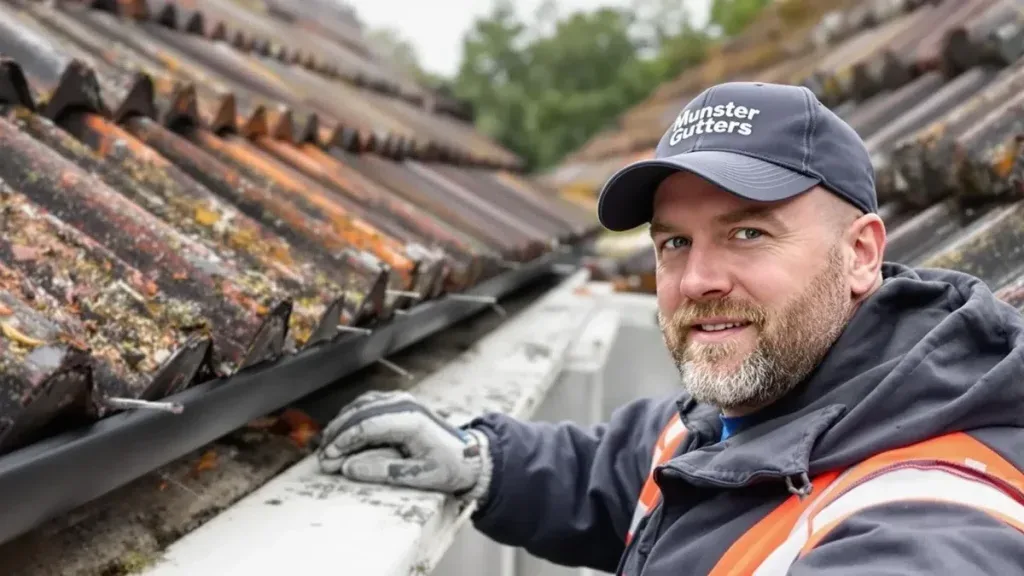





County Limerick asks more of a roof than most people realise. The city's Georgian core — the Newtown Pery grid around O'Connell Street and Pery Square — carries some of Ireland's finest late-eighteenth-century terraces, with natural slate roofs, parapet gutters and tall shared chimney stacks that demand careful, traditional workmanship. Move out through the Victorian red-brick rows off the Ennis Road and South Circular Road, into the big tiled commuter estates of Castletroy, Dooradoyle and Raheen, and on to the exposed farmhouses of West Limerick around Newcastle West and Abbeyfeale, and the roofing picture changes completely every few miles. Add the Shannon estuary — which funnels Atlantic weather straight up past Foynes, Askeaton and Pallaskenry — and you have a county where roof repair genuinely rewards local knowledge.
At Munster Gutters, we have been carrying out roof repairs across Munster since 2010, and County Limerick is home ground for us. We are council-approved contractors, carry €6.5 million public liability insurance, and back our work with written guarantees of a minimum three years, rising to ten years on major structural repairs. Every job starts with a free, no-obligation quote — call our Limerick line on 061 535761 — and we bring the same standard of care to a slipped slate in Kilmallock as we do to a full felt replacement on a period terrace in the city.
Whether your property is a Georgian townhouse in Limerick City, a modern estate home in Castletroy or Patrickswell, a village house in Croom or Caherconlish, or a farmhouse outside Rathkeale, the workmanship and the commitment to lasting results are identical. We specify materials suited to Limerick's climate — and in a county that catches the full run of Atlantic frontal rain off the estuary, that matters.
Roof Repair Types We Cover Across County Limerick
Roof Leak Repair
Tracing a roof leak in Limerick means understanding the building first. The city's Georgian terraces hide their roofs behind parapets, with concealed valley and box gutters that shed water through internal outlets — when those details block or fail, water shows up two floors down long before anyone thinks to look at the roof. The Victorian and Edwardian houses along the North Circular and Ennis Road have complex hipped rooflines with multiple junctions, and out in the county, wind-driven rain from the south-west works into aged mortar and under slipped slates on exposed elevations around Rathkeale, Newcastle West and the higher ground towards the Mullaghareirk mountains.
We trace leaks methodically — flashings, valleys and ridge lines first, then the felt and battens beneath. Where a repair can be isolated, we carry it out precisely. Where a broader area of the roof has been compromised, we tell you honestly and quote accordingly. No unnecessary work, no inflated scopes.
Slipped or Missing Slates
Slipped and missing slates are the most common call-out we get across County Limerick, and the cause is nearly always the same: the original iron nail has corroded through and let go. On the city's older housing stock — King's Island, the terraces off Mulgrave Street, the period homes of Castleconnell by the Shannon — the natural slate itself is often still sound, held on by fixings that have simply reached the end of their life. We replace like-for-like, matching slate type and size, because a patchwork of mismatched slates looks poor and sheds water badly at the joins.
In the commuter belt — Castletroy, Annacotty, Mungret, Dooradoyle — the concrete and fibre-cement slates used from the 1980s onwards fail differently: corner chipping, surface erosion, and hairline cracking that only shows after a hard frost. We carry repair stock for the profiles most common across Limerick's estates and match replacements as closely as the original run allows.
Ridge Repointing
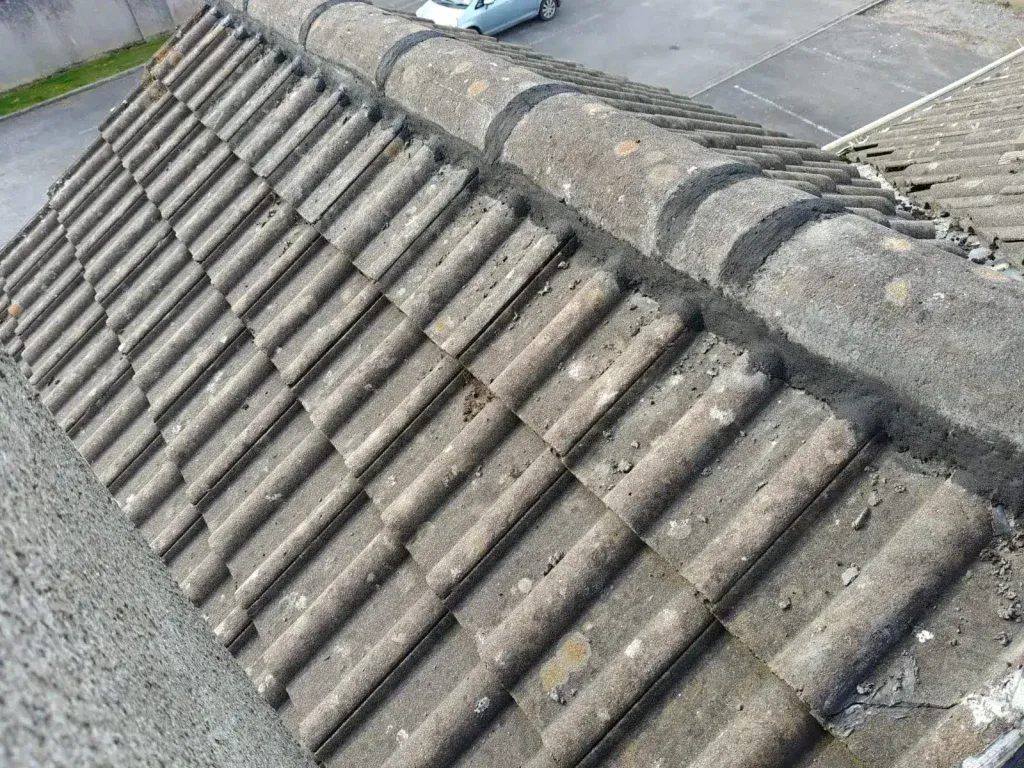
The mortar bedding under ridge tiles takes the full force of the prevailing south-westerly, and along the Shannon corridor that wind arrives with very little to slow it down. Depending on the original mix and the exposure, ridge bedding typically starts cracking and loosening after fifteen to twenty-five years; on elevated sites around Murroe and the slopes towards the Slieve Felims, it can be sooner. A rocking ridge tile is a falling hazard as well as a leak path.
We repoint ridges with a flexible mortar suited to the movement that naturally occurs at the apex, and secure tiles mechanically where required — all covered by our written guarantee. On newer estates around Patrickswell and Castletroy we also work with dry-fix ridge systems, and where a mortar-bedded ridge is failing repeatedly we can advise on upgrading to a dry-fix specification that ends the cycle.
Chimney Flashing Repair
Limerick's older chimneys are serious structures. A Georgian stack on a Newtown Pery terrace can carry four or five flues, with step flashings, soakers and lead aprons all needing to work together — and when any element fails, water tracks down inside the chimney breast and appears as damp staining rooms away from the actual entry point. The same applies on a smaller scale right across the county's villages, from Bruff to Hospital to Croom, where farmhouse chimneys have often been repointed many times over the decades with mixes that no longer hold.
We work in traditional lead and in modern lead-compatible alternatives where access or budget makes that appropriate, and we repoint deteriorated stack joints at the same time as renewing flashings — so the repair addresses the full picture rather than leaving pointing that fails twelve months later.
Flat Roof Repair
Flat roofs are everywhere in Limerick — rear extensions on city terraces, garages and dormers across the suburban estates, and commercial premises through the city and county towns. Most older flat roofs are felt, and the usual failure pattern is surface cracking, blistering and ponding as the falls deteriorate. On extensions added through the 1970s to 1990s in areas like Corbally, Garryowen and Caherdavin, we regularly find felt that has been patched repeatedly and is simply past the point where another patch is honest value.
We repair and replace flat roofs using modern torch-on felt systems and, where appropriate, cold-applied liquid membranes. For larger areas or where a guaranteed long-term solution is the priority, we offer fully specified GRP (fibreglass) flat roofing. Whichever system suits your property, we specify it clearly in advance and back it with our written guarantee.
Cracked or Broken Tiles
Concrete interlocking tiles were the default on Limerick new-builds from the late 1970s through the mid-2000s, so the big estates of Dooradoyle, Raheen, Castletroy and Annacotty are overwhelmingly tiled roofs. Concrete tile is durable but it does crack — from point impact, from freeze-thaw cycling in cold winters, and from the gradual surface erosion that eventually lets frost into the tile body.
A cracked tile needs prompt attention because the felt beneath is a secondary barrier, not a waterproof roof — sustained water flow finds its way through at the point of repeated wetting. We carry an extensive range of replacement profiles and colours, aim to match the existing roof as closely as possible, and discuss the options honestly where an exact match is no longer made.
Roof Felt Replacement
Original bitumen felt lasts thirty to forty years at best, and a large share of Limerick's housing stock is now past that mark. When the felt degrades, any moisture that passes the slates or tiles has a direct route to the timbers. On period properties in the city and in older market towns like Rathkeale and Kilmallock, we regularly open up roofs where the slates are perfectly serviceable but the felt beneath has entirely disintegrated.
Full felt replacement means stripping the outer covering, inspecting and renewing battens, installing a modern breathable membrane, and re-laying the original slates or tiles supplemented with matching stock where needed. It is a significant job — and it extends the roof's life by decades, covered by our ten-year guarantee on major works.
Valley Repair
Valleys carry more water than any other detail on the roof, and Limerick's rainfall — among the highest of any inland county, heaviest towards West Limerick and the county's southern uplands — tests them constantly. Lead valleys on older properties develop pinhole leaks and splits through metal fatigue; mortar-bedded valley tiles lift and crack; GRP valley inserts on newer roofs distort or separate from the slating if they were badly installed in the first place.
We repair and replace valleys in lead, GRP and zinc, specifying what suits the property's age, style and budget. On heritage properties — and Limerick has real heritage stock, from medieval Kilmallock to the estate architecture around Adare — we use materials and methods sympathetic to the building and consistent with any conservation requirements.
Storm Damage Repair
When named storms cross Ireland, the Shannon estuary acts like a funnel, and Limerick takes the wind harder than its inland position suggests. Lifted ridge tiles, stripped slates, felt torn at the eaves and displaced chimney pots are the standard aftermath — and a big storm also finds every latent weakness that had been quietly developing beforehand. Exposed properties around Askeaton, Foynes and Shanagolden, and elevated sites in the east of the county, see the worst of it.
We respond promptly to storm damage across Limerick city and county. Every assessment is written up in full — all damage found, not just the visible headline — and our documentation is suitable for submission to your home insurer. We do not inflate storm claims or recommend unnecessary work; our reputation across Munster since 2010 is built on honest assessment and honest pricing.
Moss and Algae Removal
Limerick's damp, mild climate grows moss on roofs almost as reliably as it grows grass. North-facing slopes in the city's terraces, tree-shaded roofs in Castleconnell and Murroe, and the perpetually moist uplands of West Limerick all carry heavy growth. Moss is more than cosmetic: it lifts slate and tile edges, holds moisture against the surface, and accelerates the breakdown of mortar joints and tile coatings. A heavily mossed roof fails earlier than it should.
We remove moss and algae with low-pressure soft-washing that cleans without damaging the surface, then apply a biocidal treatment that inhibits regrowth for several years. We never high-pressure wash a roof — it erodes surfaces and forces water under the covering. After treatment we inspect the whole roof and identify any repairs the moss was hiding, so cleaning and repair are addressed together.
Why Limerick Homeowners Choose Munster Gutters
- Serving County Limerick since 2010 — over a decade of work across the county's full range of building stock, from Georgian city terraces to estuary farmhouses to modern suburban estates.
- Council-approved contractors — vetted and approved, giving you confidence in the standards we work to.
- €6.5 million public liability insurance — full protection for you and your property on every job, regardless of scale.
- Written guarantees on all work — minimum three years on all repairs, up to ten years on major roof works, so you have a clear record of what is covered and for how long.
- Free, no-obligation quotes — we assess your roof thoroughly and provide a clear written quotation before any work begins. No call-out charges, no vague estimates.
- Honest scoping — we repair what needs repairing. We do not manufacture or exaggerate defects, and we explain clearly what is urgent, what can wait, and what is purely cosmetic.
- Material knowledge matched to Limerick conditions — from wind-rated fixings for estuary-exposed properties to heritage-sympathetic lead work on period buildings, we specify for the environment the roof actually lives in.
- Covering all of County Limerick — our teams work the city and county every week, from Limerick City and Castletroy to Adare, Croom, Rathkeale and the West Limerick towns.
Roof Repair Costs in Limerick — Pricing Guide
Every job is quoted individually after a free assessment, but these indicative ranges help Limerick homeowners budget. Prices vary with property type, materials and access; all quotes include a free consultation and a detailed written estimate.
| Roof Repair Service (Limerick) | Price Range | Typical Duration | Warranty |
|---|---|---|---|
| Emergency Roof Repairs | €250 – €800 | Same day | 12 months |
| Slate Replacement (per m²) | €80 – €120 | 1–2 days | 5 years |
| Flat Roof Repairs | €400 – €1,200 | 1–3 days | 10 years |
| Chimney Repairs | €500 – €1,500 | 2–4 days | 5 years |
| Gutter Replacement | €15 – €25 per metre | 1 day | 3 years |
| Full Roof Restoration | €8,000 – €15,000 | 1–2 weeks | 15 years |
| Heritage Conservation Work | €12,000 – €25,000 | 2–4 weeks | 20 years |
Roof repairs in Limerick City
Emergency and storm roof repairs in Limerick City
The Shannon funnels wind straight through the heart of the city, and the exposed river-facing terraces and the higher suburban estates catch the full force of the Atlantic gales that come in through winter. When a storm lifts a run of slates or ridge tiles, or damages a shared chimney flashing, water gets into these older buildings fast and can travel along a terrace roof into a neighbour's house. We respond quickly to make roofs safe and weathertight, using temporary cover where needed or a same-visit permanent repair where the weather allows. Emergency call-outs typically fall in the €200 to €600 range depending on access and what the storm has done.
Storm damage in the city is often less dramatic than it looks from the pavement. A few displaced slates, a cracked mortar bed on a shared ridge, or a lifted flashing around a chimney stack can all let water in without any obvious hole, and on multi-storey terraces access makes early diagnosis all the more valuable. We inspect the whole roof slope rather than patching the one spot you noticed, because on a run of city terraces the same gust that moved one slate has usually loosened others along the row.
Georgian and heritage-terrace roofing in Limerick City
Limerick's Georgian terraces and redbrick houses are among the finest in the country, and their roofs need a traditional, careful approach. These properties typically carry natural slate on timber battens, lime-bedded ridges, valley gutters between the slopes, and cast-iron rainwater goods, much of it decades past its design life. The shared chimney stacks that run up between houses are a particular weak point: their flashings and lead work fail and let water into two homes at once. Repairing these well means matching slate sizes and colours, re-bedding ridges in the right mortar, renewing lead flashings and valley linings, and respecting how the terrace was originally built. We are happy to work slate for slate on these homes so the repair blends in and lasts.
Commercial and flat roofing in Limerick City
As a working city, Limerick has a large stock of commercial roofing: shops and offices in the centre, retail and light-industrial units on the approaches, and the flat or low-pitch roofs behind many period frontages. These are typically finished in felt, EPDM or single-ply membrane, and they fail differently from a pitched roof, with ponding water, split seams and blocked outlets the usual culprits. We repair and re-waterproof flat commercial roofs with as little disruption to trading as possible, and we will give you a straight assessment of whether a section needs patching or genuine renewal. Larger flat-roof works generally sit in the €1,200 to €2,500 range depending on area and build-up.
Looking at a bigger job than a single repair, or comparing options across the county? Our roof repairs Limerick page covers every repair type we carry out county-wide, with indicative pricing and answers to the questions Limerick homeowners ask most.
Limerick City weather and your roof
How does the Shannon affect Limerick city roofs?
The Shannon runs straight through the city and channels wind and driving rain across the river-facing streets, so exposed frontages take weather from the side as much as from above. That drives water at the verges, ridges, flashings and the shared chimney stacks, which is why those junctions tend to fail before the main slope does. Keeping the flashings and stack details sound is the single most useful thing you can do for a Limerick city roof.
What roofing problems are most common on the city's older terraces?
On the Georgian and redbrick terraces and the older corporation rows, the most frequent problems are slipped natural slates, cracked mortar bedding on shared ridges, failed valley linings between slopes, and tired lead flashing around the shared chimney stacks. Because the roofs are connected, one weak point can affect two houses. Catching these early, ideally with a check after the first big autumn storm, stops a minor slip becoming a soaked ceiling.
When is the best time to repair a Limerick city roof?
The drier spells from late spring through summer are ideal for planned repairs, re-bedding, and lead and valley work that needs settled conditions. Autumn is the time for a precautionary check so small defects are fixed before the winter gales come up the river. We carry out emergency repairs in any weather, but planned work always lasts better when it is done dry.
Limerick City property types
What roofing issues affect Limerick's Georgian and redbrick terraces?
These period terraces typically carry natural slate, lime-bedded ridges, valley gutters and cast-iron rainwater goods, with shared chimney stacks running up the party walls. Common problems are slipped and delaminating slates, cracked ridge bedding, failed valleys, and lead flashing worn out around the stacks. Chimney flashing and repointing on these shared stacks is a frequent and important job, usually falling in the €600 to €1,500 bracket depending on height and access.
How do the 1930s to 1970s corporation houses and semis differ for roof repairs?
The corporation housing and semi-detached estates from the mid-twentieth century often carry either natural slate or early concrete tile that is now reaching the end of its reliable life, with mortar-bedded ridges that have cracked and let tiles or slates work loose. Repairs range from swapping individual tiles and re-bedding ridges, often €300 to €800, up to larger sections where the underlay has failed. Shared chimney stacks feature here too and bring the same flashing and repointing work.
What about Limerick's newer suburban homes?
The more modern estates around the city edge generally carry concrete interlocking tiles with dry-fix ridges and modern membranes. They are not maintenance-free: dry-verge and dry-ridge clips can work loose in high wind, and flashing around dormers and rooflights is a common leak point. These repairs are usually quick and targeted, often in the €300 to €800 range once the failing junction is found.
Roof Repairs Limerick — FAQs
My house is a Georgian terrace in Limerick City — does the parapet roof make repairs more complicated?
It changes how we work, yes. The Newtown Pery terraces typically hide the roof behind a parapet, with box or valley gutters draining through internal outlets — so problems are invisible from the street and often from the attic too. Access, inspection and repair all need to be planned around those details, and blocked or failed parapet gutters are one of the most common causes of "mystery" damp in the city's Georgian stock. We assess the full parapet and gutter detail as part of every quotation on these properties, and we work in traditional materials appropriate to the building's age.
We are near the estuary at Askeaton — does that exposure affect how quickly roofing materials fail?
It does. The Shannon estuary gives Atlantic weather a clear run into west Limerick, and properties around Askeaton, Foynes, Pallaskenry and Shanagolden take wind-driven rain and salt-influenced air that inland parts of the county largely escape. Metal fixings, lead flashings and mortar joints all age faster in those conditions. We factor the exposure into our specifications — higher wind-rated fixings, marine-grade sealants where warranted — and we recommend slightly more frequent inspections for estuary-exposed roofs than for a sheltered property in, say, Caherconlish.
How long will a roof repair last in West Limerick's wet climate?
Newcastle West, Abbeyfeale and the higher ground towards the Mullaghareirks catch some of the heaviest rainfall in the county, but a repair carried out to a proper standard lasts as long there as anywhere else — our guarantees apply equally regardless of address. The key is specifying for the exposure rather than applying a standard mix everywhere: a ridge mortar that performs fine in a sheltered Castleconnell garden may not hold on an open hillside above Abbeyfeale. We adjust the specification to the site, and our three-to-ten-year written guarantees reflect a job done correctly for the specific conditions.
Is there a call-out charge for a roof repair quote in County Limerick?
No. Quotations are free and without obligation everywhere in the county — the city, the commuter towns, and rural West Limerick alike. We carry out a proper on-site assessment, not a drive-by glance, and provide a written quotation setting out the recommended work, materials, timeline and the guarantee that will apply. Call 061 535761 and we will arrange a time that suits.
Will my home insurance cover storm-damage roof repairs in Limerick?
Storm damage is typically covered by home insurance. We provide detailed reports, photographs and written cost estimates for your claim, work directly with loss adjusters, and can carry out emergency temporary repairs to make the roof weathertight while the claim is processed.
How fast can you respond to an emergency roof repair in Limerick?
For urgent situations — storm damage, a major leak, slates off in high wind — we aim to respond within a few hours across Limerick city and the main county towns, making the roof safe and weathertight first and completing the full repair once the weather allows.
Do roof repairs in Adare or another conservation area need planning permission?
Like-for-like repairs generally do not, but Adare is one of Ireland's best-known heritage villages and much of it is protected — changing roof colour or material there, or on protected structures in Limerick City and Kilmallock, can require permission. We use period-appropriate materials as standard on heritage stock and can advise on, and work within, any conservation requirements that apply.
How does Limerick's climate affect roof repairs, and how should I look after my roof through the year?
Limerick catches Atlantic frontal rain funnelled up the Shannon estuary, so roofs here work harder than the national average. The practical answer is seasonal: clear gutters and check flashings in autumn before the winter storms, deal with slipped slates and moss build-up in spring, and use wind-rated fixings and enhanced waterproofing on exposed and estuary-facing homes. A quick check twice a year catches small faults before a winter downpour turns them into a leak.
Do Georgian and Victorian period homes in Limerick need a different approach to roof repairs?
Yes. The Georgian core around O'Connell Street and Pery Square, and the Victorian terraces off the Ennis Road and South Circular Road, are natural slate on timber, often with lime mortar, parapet details and cast-iron rainwater goods — and many sit in architectural conservation areas. Repairs should use matching natural slate, period-appropriate materials and traditional techniques rather than modern substitutes, both to keep the character and to satisfy conservation requirements. We work to those standards and can advise on any approvals needed.
What about roof repairs on newer estate homes in Castletroy, Dooradoyle or Raheen?
The modern developments in Castletroy, Annacotty, Dooradoyle, Raheen and Mungret are typically concrete or clay tile on standardised roof structures. Repairs there are usually straightforward — replacing cracked or slipped tiles, re-bedding or upgrading ridges, and sorting flashing or valley leaks — and we carry the common tile profiles to match. Same free assessment and written quote as anywhere else in Limerick.
Do you repair roofs on farm buildings and rural properties in County Limerick?
Yes. A large share of our county work is rural — farmhouses and outbuildings around Croom, Bruff, Hospital, Kilmallock and across West Limerick. That includes slate and tile repairs on dwellings, felt and sheeting work on outbuildings, and storm damage response. Rural access rarely causes any difficulty, and quotations are free county-wide.
Can you match the existing slate or tile on my Limerick roof?
Nearly always. We stock the slate sizes and tile profiles most common across Limerick's housing stock, from natural slate for the city's period terraces to the concrete interlocking profiles used across the suburban estates. Where an exact colour or profile is no longer manufactured, we source the closest available match and show it to you before any work proceeds — a mismatched repair is a poor repair, whatever else is right about it.
How quickly can you get to a property in Limerick after storm damage?
For emergency storm damage we prioritise call-outs across County Limerick and aim to attend within 24 to 48 hours of contact depending on volume following a major weather event. If the repair cannot be completed immediately — for example if specialist lead work or a material order is required — we apply a temporary weatherproof cover on the same visit to prevent further water ingress. We then schedule the full repair as soon as materials are on hand, and the guarantee runs from the date the permanent repair is completed.
My house is in the Georgian Quarter in Limerick City — does that affect how you approach the repair?
Yes, and we plan for it. Properties in the Georgian Quarter and other protected streetscapes in Limerick City may be subject to planning considerations, and the materials and detailing appropriate to a Georgian or Victorian building differ from those used on a modern estate house. We work with lime-compatible mortars where required, source natural slate to match existing coverings, and dress lead to the correct code and profile. If there is any doubt about whether a planning exemption applies to a proposed repair, we advise the homeowner before any work begins rather than after.
Is it worth repairing an older roof in a county town like Newcastle West or Kilmallock, or should I just replace it?
That depends on the overall condition of the structure, and the honest answer only emerges after a proper inspection. Many older roofs in the county towns have sound timberwork and good-quality original slate that will outlast a modern replacement by decades — they simply need targeted repairs, repointing and perhaps a felt replacement. We will always tell you plainly if a repair is a false economy and a full replacement is the more cost-effective route. The free quote includes that assessment, and we have no commercial incentive to push unnecessary full replacements when a repair will serve the building well.
What guarantee will I receive on a roof repair in Limerick?
All roof repair work carried out by Munster Gutters in County Limerick is covered by a minimum three-year written guarantee. On larger or more complex jobs — full felt replacements, extensive valley re-leading, comprehensive ridge repointing across a whole roof — the guarantee extends up to ten years. The guarantee is written, specific to the work carried out, and tied to Munster Gutters as a trading business, not to an individual operative. We are council-approved and have been operating continuously in Munster since 2010, so it is a guarantee with genuine substance behind it.
Looking at a bigger job than a single repair, or comparing options across the county? Our roof repairs Limerick page covers every repair type we carry out county-wide, with indicative pricing and answers to the questions Limerick homeowners ask most.